Article: “Elia Kazan Interview- On the Waterfront”

“Elia Kazan Interview- On the Waterfront”
Transcript of the interview with director Elia Kazan of Marlon Brando’s, Academy/Oscar Award winning, movie “On the Waterfront“. The interview was featured in the special edition DVD of the movie.
Copyright 2001 Columbia Tristar Home Video, Inc.
I wanted to make film about the Waterfront and I worked with Arthur Miller on a film about the “Red hook” about the Waterfront in Brooklyn and for various reasons pressures – political pressures one thing or another- and that broke up and I was still determined to do it. I thought it was exciting. I was reading about it all the time and I saw it all the time I used to walk around a lot than I saw it.
Elia Kazan and Marlon Brando during the filming of “On The Waterfront”
I was fond of the [New York] city so to say you know I’m not-I’m not living in California, I’m living in New York City and that’s different and just like in the taxi-strike, I was in the taxi strike and so forth and I mean all those things were real to me because I live in them. Anyway, I said to Bud Schulberg, I said that thing just broke up, he said I’ve been working on a story about the Waterfront for a long time and he had these articles by Johnson and so forth and he let me read me the script and I thought the script could be helped and we worked on the script together.
Elia Kazan as seen in the DVD special feature interview
We’d also met a fellow in Hoboken in his house. We had dinner together several times and he was Tony Mike and he went through the exact same experience and so I got to know him and he would tell me what he went through and what he’d felt- the scorn thrown at him and I had a good deal of scorn thrown at me in those years, so, I was hefty so could take it and he too, but, he was tough- he was ready to fight all the time and that helped me a lot- seeing this man- he went through the whole damn thing that on the waterfront was about and was in a fury about it so [pauses] it was a great experience all along. I used to hang around in Hoboken but not like Bud [Schulberg] did, Bud was there all the time. Bud lived there and I mean it was a great great writing experience for me to watch him put that film [On the Waterfront] together.
Bud Schulberg and Elia Kazan with the Oscars
Bud was great he never stopped work and I said this is just the thing for Zanuck- this is right down Zanuck’s line. He loves violent stories about big cities and so forth. I showed it to Zanuck and he said I’ll make some suggestions and he did and then one day he called us into his office and he said I’m not gonna do this, I don’t like it. And in came this terrible terrible guy that I’m very fond of now named Sam Spiegel. And he was down on his uppers. He was broke- he had trouble He needed something that paid him produce and so forth, but, he also needed something to do.
Sam Spiegel and Elia Kazan
Bud came into my office, we were all sort of in the same hotel, Fox was still paying our expenses and Bud said he’s gonna do it and I said “You’re kidding!”- he said no. He said he’s gonna do it- he means it. Then Sam- we spoke to Sam and said I’m gonna do it right away- he said let’s go to New York, so we went to New York. Well, Sam drove Schulberg crazy and he said let’s open it up again- let’s open it again- let’s reexamine it- let’s see if we got it right and he worked on the script thinning it down and tightening it up and Bud was great, he never stopped and between them they worked like- and I think between them although they had a lot of antagonisms. I tell the thing in my book, but, I’ll tell it again too- One night Bud was living in the country in Pennsylvania and one night his wife woke up about 3:30 in the morning and looked in the bathroom and Bud was shaving and she said “Bud, what the hell are you shaving for at 3:30 in the morning?”- he [Bud] said “I’m going to New York” – she said “what are you going to New York for?”- he said “I’m going to New York to kill Sam Spiegel” [Kazan laughs] he was that mad at him. He did go to New York but he never killed Sam Spiegel. Sam Spiegel was a very tough guy. Tough because of his experience in Europe because he just escaped with his life I imagine and he kept adding abd Bud kept adding and then we were lucky enough to get Marlon [Brando] in it.
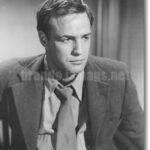
Marlon Brando
And so we made a film that is from the point of view of Screenplay, I think, was perfect. It’s a wonderful screenplay with a wonderful actor and it worked out well. Also, by then I was trained to work with people on location and I enjoyed it- I enjoyed the longshoremen- I liked them a lot. I used to have a bodyguard, but only once was it necessary- one fellow once punched me out but my bodyguard came up and pushed him against the wall and that was settled. It was a great experience for me because I was on my feet all the time in the city and I think from that point of view it’s how close I came to making a film exactly the way I want.
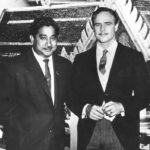
Marlon Brando with his parents during the filming of Waterfront
It was a cold winter and we were shooting it in the winter. As we went along it was more and more into the winter- more and more cold, rain and we never stopeed shooting. Wen had these great barrels there and people would break down boxes and the longshoremen throw them into the [thing] and we had hot boxes all the time and Brando sometimes had to go ito a hotel- what’s it called a “Majestic” hotel- some phony name- I had to go in and drag him [Brando] out because it was too cold out there and he [Brando] is not very hardy in someways and also the cold helped the actors’ faces- they looked a certain way they were sunk in here [points to the cheeks of the face]. They didn’t have this lovely flesh of success that the leading men and actors in Hollywod have- dimpled pink beautiful complexion- they were miserable looking human beings and that includes Brando and Eva [Marie] Saint was perfect- just the thin little, seemingly undernourished Catholic girl- over proper Catholic girl.
Marlon Brando, Eva Marie Saint and Elia Kazan
It really was a terrific cast. But when I think back it was Bud’s [Schulberg] persistence and Spiegel’s insistence that help make that movie [pauses] and what Brando contributed to it. Just externally he is very gritty. I mean he liked those streets, he liked those people, he liked those longshoremen- he used to lay around on the roof and talk to them. But that wasn’t it- the thing with Brando is that in Brando there is both an ambivalence side- and the ambivalence consists of a toughness, an exterior toughness- and a tremendous desire for gentleness and tenderness and the best scenes in the movie, from my point of view, are the love scenes with Eva Saint where he’s [Brando] asking her to understand him- where they’re sitting in a cafe. He’s great in those scenes. Why because, this tough guy revealing a side to himself that you did not expect and a side of himself that exists in the audience point of view because they recognize him- was sort of tenderness some sort of- people wanted to reach out for him to help him and at the same time he’s a son of a bitch and a bad person and a betrayer, still you wanted to help him and she [Eva Marie Saint] too and that’s what came off, that’s what came off. he has that ambivalence in him- I was lucky I had him, it worked out well because he’s both hardy and indifferent and at the same time [he] wants you to love him very much.
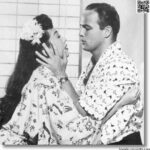
Marlon Brando with Eva Merie Saint
Kazan: “The best scenes in the movie, from my point of view, are the love scenes with Eva Saint
When he [Brando] plays those scenes with her [Eva Marie Saint] I’m broken up, I break up. Ah…ah…that one person should need so much from another person in the way of tenderness and all that. We all do, don’t we, we all marry- hopefully marry or hopefully hook up with some lady that’s gonna make us feel- we’re ok and we’re better and all that. We search for it and we want it and crave it and all that and sometimes it happens and sometimes it happens for a while and something in that basic story is what stirs people; not the social political thing so much as the human element in it.
Elia Kazan: “That basic story is what stirs people; not the social political thing so much as the human element in it”
What can I say about this [“contender”] scene? Everybody has seen this so often there’s nothing I can say- it’s played so often. I can say this that the two actors [Marlon Brando and Rod Steiger] made it. I didn’t do directing- believe it, it’s true. I’m not- I’m not falsely a modest man, but, we had a very thing from [Sam] Spiegel; he didn’t get us a set- we only had a shell of a taxicab. We had a good cameraman you saw that, but, we came there at 11:00 in the morning; very discouraged. So, I just put the two actors in the back seat and he [cameraman] flicked some lights on and we had a little sound affect and then they acted the scene. They new the characters by then; they liked each other, Rod and Marlon, and the scene just rolled off without- I mean, it sounds falsely modest but it’s not. I didn’t really direct the scene, they did it. They made the scene, those two men. It’s a big lesson you know. If you get to a certain point when the actors know what the hell they are doing and the script is right, the scene right- how you gonna beat it? “I couldda been a contender”, you can’t beat that line. It is a wonderful line; that’s Bud’s [Schulberg] line and Bud wrote the scene beautifully.
The famous “Contender” scene: Rod Steiger and Marlon Brando
I don’t understand how people caught on to “On the waterfront” that fast. Because it didn’t have a lot of publicity at the beginning and I went down the morning it opened and they were hundred people in line. I don’t know who the hell was in line. They may have been the hoodlums who heard about it in Hooboken, I don’t know, there they were. It was an enormous success immediately and I’m not sure if it was because of what the papers wrote about it. Something they sensed in it. Something of the drama of the ordinary man who has feelings of guilt, who’s searching for redemption- it’s not a big word in the Catholic religion; in all our religions- redemption- redemption- the film in a way is about redemption; a dumb innocent kid who’s done terrible things and wants to be redeemed and the girl redeems him- wow, that’s basic isn’t it!
Copyright 2001 Columbia Tristar Home Video, Inc.
Important Copyrights Information:
This is a purely non-commercial site intended for entertainment purposes and for Marlon Brando fans around the world. I DO NOT OWN ANY COPYRIGHTS OF THE ARTICLE LISTED IN THIS PAGE. Though regretted, request for removal of any copyrighted material, by the owner, will be promptly complied with.



No responses yet