
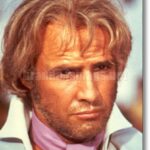
The Missouri Breaks, 1976, as Robert Lee Clayton
Cast: Jack Nicholson, Randy Quaid, Kathleen Lloyd
Director: Arthur Penn

Rating

Factoid
–


–
“Candid conversations with the Leading man”
Interview with Marlon Brando during the filming of the movie by Bruce Cook
[Copyrights United Artists]
You wouldn’t believe it. Here I am in Billings, Montana, and all anybody in this undergrown prairie city can talk about is Marlon Brando. I register at the Ramada Inn, and just as I’m signing my name, the girl at the desk leans over and says in confidential tones, “Did you know that Marlon Brando is here?”
“Here? You mean at the Ramada Inn?”
“Well. . . no.” She seems a little miffed and goes on the defensive. “But he’s right here in Billings. He’s making a movie just outside of town.”
“I know. That’s why I’m here.”
I could tell I had suddenly grown a foot in her estimation. She doesn’t have to know I’m not actually involved in the movie; just came to write about it. Man of mystery.
The bellboy is about nineteen or twenty and a nice kid. I slip him a buck, and as he’s doing the ritual check of light switches and bathroom linen in the room, he happens to mention oh-so-casually, “Guess you’ve heard they’re making a movie here.” “That a fact?” Playing dumb.’ “Who’s in it?” “Marlon Brando! Far out, huh? Right here in Billings. I saw him night before last.”
“Really.”
“Well, they said it was him, anyway, in this camper out on Rimrock Road. I didn’t get such a good look myself.'”
One table away in the dining room forty-five minutes later there’s a family right out of a Doris Day movie from the 1950s. The cute blonde-she’d be the Sandra Dee part-leans over and says to her older sister, Doris, “Well, honestly, I don’t see what it would hurt. I mean, we could just drive out there, couldn’t we, and ask them if we could watch for a while’? The very least they could do is say no.” “That’s just it!” says Doris. “They would say no.” “But we might get to see him!’
“Just a minute,” says Daddy. “Who’s this him, anyway?”
“Oh, Daddy, you know. Marlon Brando.”
“Oh.” You can tell from the frown that crosses his face that he’s remembering Last Tango in Paris. Even if he hasn’t seen it, he’s heard about that stick of butter. “Well, never mind about that. I can tell you we’ve got lots more important things to do than drive around the boondocks looking for. . . him.”
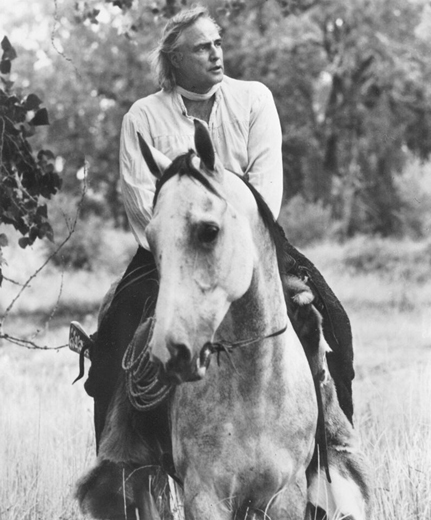
Marlon Brando as Robert Lee Clayton, a regulator. “Regulator” is a euphemism for hired killer
There are stars, and there are superstars, and then there is Marlon Brando. Nobody can cause the excitement he can just by being in a city, making random appearances getting in and out of cars, or making sudden, unexpected visits to a bar or restaurant. Rumors are rampant. News of “sightings” (as of a UFO) run through Billings as though instantaneously transmitted on microwave. Why’? He’s a magic person, that’s why. Brando is one of those figures in whom we invest our fantasies. If you are a woman, you ask yourself what it would be like to be made love to by such a man, or simply to talk to him in an intimate, personal way. If you are a man, you wonder what it would be like to occupy his space, to have his options, simply to be him. There are only two or three such figures given to each generation. Lord Byron was one; only Napoleon,
In his time, was as luminous a figure as he. Once, at a ball, Byron stood accepting the adulation of the great ladies of England when one aggressively thrust herself forward and said she would like to know the real Lord Byron. “Madame,” he said to her plainly, “there is no real Lord Byron.” And he meant it, for Byron knew-just as Brando now knows-that the fantasy figure that bore his name had little or nothing to do with the human being he was. It’s something you can imagine Brando saying, isn’t it’? There is no real Marlon Brando. And you can be sure that if he did, people would say, “There he goes, playing the smartass again!”.
The Missouri Breaks is the name of the movie. All you have to do is say, “Starring Marlon Brando and Jack Nicholson, and directed by Arthur Penn,” and you figure it’s got to be terrific. These three came here for the opportunity to work with one another am to take the kind of chances that you would expect two such actors to take with the man who made Bonnie and Clyde and Little Big Man.
Early the morning after my arrival, I am being driven out to the set. We barrel out to the edge of town and at the foot of the rimrocks, a kind of extended mesa of solid rock that overlooks Billings from the west, we hang a left and head south into the plains. It’s a long drive, and once we are past the riinrocks, it all looks the same-nothing but wheat fields, and off to one side in the dim, hazy distance are the Rockies, deep blue and powdered white on top.
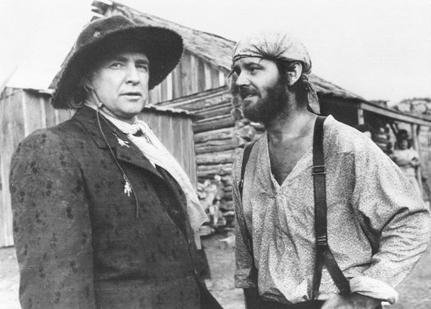
Jack Nicholson as Tom Logan, a horse thief
In The Missouri Breaks, Nicholson and his gang of horse rustlers-Frederic Forrest, Randy Quaid, Harry Dean Stanton, and John Ryan-have fallen into a feud with a rancher, stealing his stock, lynching his foreman. , Because the rancher can’t handle them alone, he brings in Brando, a hired killer who describes himself as a “regulator.” Brando goes after the gang and murders them one by one. Soon it’s down to Brando and Nicholson.
The antagonists face off. The final duel commences. . . Well, you get the idea.
We’re almost to the set. Casey takes a left off the highway onto a dirt road at a small sign with an arrow marked EK. That’s EK for Elliott Kastner, the producer of the picture. An ex-film agent, literate and intelligent, Kastner is characteristic of the new breed of independent producers in Hollywood today, and. he is one of the most successful of them all. He Just signed a new multi-picture contract with United Artists which will assure him backing for many projects to come. Right now he’s their boy. But why shouldn’t he be? Any guy who can get Brando and Nicholson together in the same film. deserves all the financing he can get-and probably needs it, too. The two of them together cost him a reported $2 1/4 million, a million for Nicholson and one-and-a-quarter for Brando.
Kastner and Brando had worked together on one earlier film, The Night of the Following Day, in which Brando appeared with Rita Moreno and Richard Boone. When most people think of Brando, they think of him either as he is today, on top, with The Godfather and Last Tango in Paris behind him. Or they may remember him as he was when he first hit the screen in that glorious string of performances-A Streetcar Named Desire, Viva Zapata! and On The Waterfront -that no actor before or since has ever quite equaled. They forget that there was an even longer string of pictures which immediately preceded The Godfather that marked the nadir of Brando’s career. They were movies so eminently forgettable that it is difficult now even to summon up their titles-Bedtime Story, Morituri, A Countess from Hong Kong, The Appaloosa, and so on. There was some doubt back then that Brando would ever make a comeback, and those. who said confidently that he wouldn’t often had smiles on their faces. Elliott Kastner knew him when Brando’s fortunes were as close to bottom as they are ever likely to be. Brando was doing well enough financially in those days, getting his million dollars a picture, but that went to support three different children in three different households. What was saddest of all was that he seemed to have lost his interest in his craft. “Acting,” he declared then, “is a bum’s life in that it leads to perfect self-indulgence. You get paid for doing nothing, and it all adds up to nothing.” And that attitude began to show in some of his performances-though not in all-so that if he were in a number of bad movies, he himself may have helped a little to make them bad. Or at least he failed to do what he could to make them good, which amounts to the same thing. Why? It has been said of him that he bores easily, and is suggested that this is the reason for the deep troughs between the crests in his career. But there may be more to it than that. It may be that when an intelligent and imaginative person masters a craft as completely as Branda has mastered acting, then there must be elements of struggle and challenge introduced into the process somehow-anyhow, even artificially-or eventually he will lose interest in his work completely. The struggle? That was in coming back from the e le of mediocrity and indifference to which he had condemned himself. The challenge? Doing The Godfather and Last Tango in Paris back to back. Francis Ford Coppola, and especially Bernardo Bertolucci, asked of Branda almost more than he had to give, more than any actor had it in him to give. But somehow he did manage to provide what they demanded. He met the challenge, and now he’s back on top.
You only have to step foot on the set of The Missouri Breaks to find that out for yourself. He is the focus of attention here. When he is outside the camper in which he lives, right on the set, every eye seems to stray in his direction. When he’ is working in front of the camera, people who are not directly involved come over-casually enough, it seems-just to watch. And when he is not around, they talk about him.
Frederic Forrest is a good young actor whose first part was the lead in a memorable movie called When the Legends Die and who appeared in the title role in Larry, one of last year’s best films on television. He does more than watch Brando; he studies him.
“The guy’s incredible,” says Forrest. “He builds character from everything. There are always little surprises, little details in his work, so that something is going on every moment.”
The chance to work with Brando, to watch him build a role, was one of the big reasons he signed on for The Missouri Breaks in the first place. During a break in filming, we sit outside the rustler’s cabin under the hot Montana sun and talk about a lot of things. He tells me, for one, about growing up in Texas where all the acting he was exposed to was in the movies he would go to every Friday night. “I don’t think I would ever have gotten it into my head to be an actor at all if it hadn’t been for Brando and James Dean and Montgomery Clift. They showed me something I wanted to be. And I heard that New York was where it was happening, where those guys began, so that’s where I went. “Brando . . . he’s something else.”
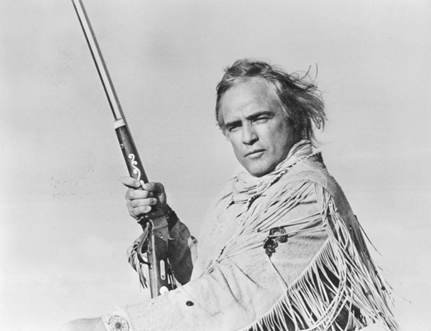
Robert Lee Clayton hired to eliminate the rustlers
He is the favorite of the crew. Shooting had already been in progress a couple of weeks when Brando showed up to begin his role. That morning he went around to every crew member-electricians, sound-men, grips, everybody-and introduced himself, shaking hands, asking names, telling them that it was a pleasure to work with them. He acts like it’s a pleasure, too. He buys the booze when there’s a celebration. He goes to the birthday parties. And he does it all like he means it, they say, and not like he was a big star popping for the peons.
He is a big star, though, even to them. You might suppose that a movie crew would be immune to the sort of fascination most people feel in the presence of actors and celebrities. And for the most part they are. But with Brando it is different.. As prop man Guy Douglas puts it, “The. crew feels that Marlon Brando is their hero.”
They like his guts and playfulness, too. It suits them just fine when Brando goes zipping around the set on his little 90cc Honda, reducing Elliott Kastner to a state of apoplexy. When Brando got Jack Nicholson to hop on behind and the two of them took off cross-country, bounding over hillocks and bouncing over rocks, Kastner was heard to ask, “Have you got any idea how much money is riding on that thing?” Just, about that time they took an especially bad jump and tumbled over. The two stars came-up laughing, but the producer was profoundly unamused.
“Whatever else you hear about him, Brando’s got guts, all right,’ says makeup man Robert Dawn. “He’s doing his own stunts: I saw him take a twenty-five-foot jump out of a tree, just grabbing branches to break his fall; that would have been a pretty good gag even for a professional stunt man.”
Arthur Penn: quick, nervous, intellectual. He is described by Frederic Forrest and others in the cast as a steadying influence, but the pressure is on him, and he is beginning to show the strain. He talks fast and says as little as possible.
“Yes, there’ve been some delays,” he admits, ” but you expect those on a picture like this. And after all, the job is getting done.”
“What kind of picture do you mean by ‘a picture like this’?” I ask him.
“A big picture, one with big people in it, and it puts some strain on me. You expect that, though. They are a lot of original people with a lot of original ideas. That keeps it interesting.”
I’ve seen a number of directors at work-Mike Nichols, Sam Peckinpah, Jan Kadar, Bill Friedkin and coming away from Arthur Penn was the first time I’ve failed to wish I could do that, too. All of a sudden it didn’t look like much fun. One of the crew told me that he had never worked with a director who shot so much “cover” -the same action shot from a lot of different angles. Which makes Penn extra-thorough, I guess, but maybe a little worried, too.
The way this movie came together all at once, it’s like a $5 or $6 million accident. Kastner had the script. Arthur Penn was available and got Brando interested in the project. nrando needed the money for a lot of environmental experiments he is initiating in Tahiti. And if Brando was interested, then Jack Nicholson was interested, too. And it all clicked into place somehow in not much more than a week. Ordinarily that would be all right, but in this case there just wasn’t much time for the sort of careful production preparation that is usually the mark of an Arthur Petm film. Locations were scouted from the air. Costumes were designed and done in four weeks; time. A couple of the supporting roles were cast with actors who had barely seen the script.
Kathleen Lloyd, who plays the rancher’s daughter and is just about the only woman in this thunderingly macho movie, was hired on the strength of some television film her agent had on her. No screen test. No rehearsal time. She didn’t get to meet Jack Nicholson, her leading man, until she arrived here in Montana. It’s a nice picture for a girl who has only had television experience before. But she’s quick and smart, and the word is, she’s handling herself pretty well.
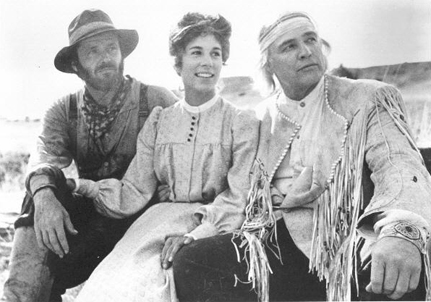
Nicholson, Kathleen Lloyd and Brando-All three never appear together on camera, but they did for the still man
“What’s it like,” I ask, “working with Brando and Nicholson your first time out?” It’s a dumb question, but sometimes it’s best to be direct.
“What can’ I tell you? It’s what you would think. It’s many things.”
“Name one.”
“Well, I mean the energy there is incredible. It’s very intense in front of the camera. All I can do, all I try to do, is to stay open for all the moves. Things get going pretty fast, and I don’t want to fall off.”
If Jack Nicholson is feeling that kind of pressure, he isn’t showing it; He’s a hard guy to get a fix on. Casual enough, friendly in a superficial way, but there is something oblique, indirect, almost withdrawn about him. He confirms what I had figured: that this is the first Western he has appeared in since Ride in the Whirlwind, one of the famous “lost” movies from the days before he first hit it big in Easy Rider.
“That’s when. I learned to ride a horse, making those two Westerns with Monte Hellman. This is a crazy business. You learn that kind of stuff making movies-how to ride a horse, how to shoot guns. . . .”
“How to ride a motorcycle?” I prompt him. “That, too.”
From time to time we are interrupted by members of the crew and a few locals who have talked their way onto the set. They ask to take his picture, to have a picture taken with him. He’s. cooperative, pleasant, affable. But his mind seems elsewhere. I notice that he is looking rather often’ at’Brando, who is off to one side, getting ready for a take that will be shot across a wide gorge, a long shot which Penn and the camera crew are setting up even then. I’m reminded that Nicholson is said to live in roughly that sort of relationship to Branda back in Los Angeles, on Mulholland Drive. His house is on a hill, directly opposite Brando’s, which stands close by on another. Maybe that means a lot to a guy like Jack Nicholson. You can be sure it means something.
As Brando waits while, the shot is being set up, he practices throwing a mean-looking four-pronged pike into a fence post; it is one of the arsenal of rare killing instruments with which the Brando character, Robert Lee Clayton, dispatches his victims. Nicholson watches, saying nothing for a while, and then admits:
“I was just thinking. You look at those two guys, and you realize the difference in temperaments we’ve got working on this movie. One of them is throwing a pike in the post-looks dangerous. The other guy” -he points across at Arthur Penn-“is looking down at the ground, trying to decide what to do next.” He hesitates, then adds, at his own expense: “And me, I’m in the middle, talking to a writer. I call that an unbeatable package.” Nicholson suddenly laughs.
“I hope the combines didn’t bother you last night, Mr. Brando.”
“No. That stuff doesn’t bother me. Nothing bothers me out here. I like it.”
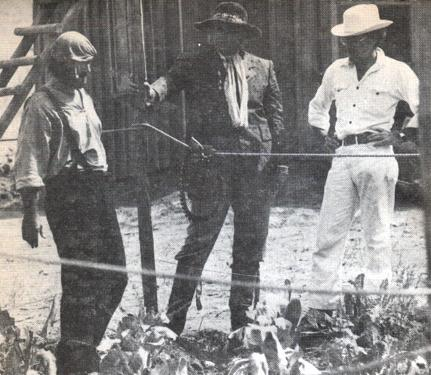
Marlon Brando and Jack Nicholson with, director, Arthur Penn, rehearsing the first confrontation
Marlon Brando is talking with the people who own the ranch on which the movie is being shot-or at least this piece of the movie. Since he is staying right on the set in his camper, he is their guest, too. They like that. They are decent people, and he is being decent right back at them. Their daughter Ona comes over, and they introduce her. He, in turn, tells them about the beautiful rocks he has found in the vicinity -“Even saw some petroglyphs, three of them, down there among the boulders.”
And so on. But about this time he notices me as I face unobtrusively in the opposite direction, taking it all down in my notebook. It’s a sneaky way to operate, I admit, but I had been warned Brando probably wouldn’t talk to me, so I 0 thou,ght, what the hell, I might as well take down whatever I hear, because he might say something interestirig. I had tried to be discreet but somehow he had noticed, and before I am quite prepared, here he is, a huge presence, regarding me sternly, asking me who I am and what I am doing with the notebook. I tell him who. I tell him why. And he says, “Forget it. I’ll talk to you.” And he hustles me into the little cubicle section of the trailer dressing room. It is warm but it is private.
“Go ahead,” he says, “ask me what you want.” I am suddenly convulsed with a paroxysm of uh-uh-uh’s-unable, quite, to come up with the kind of magic questions that may unlock him, so I fall back instead on one about all the changes in the script, and the improvisations on it I’ve heard so much about.
He shrugs. “Well, we’re shooting on the run. But with almost any good movie it’s impossible to plan it until you’re right there. When you live in the circumstances. the reality of it comes to you, for better or for worse. Movies are actually improvisations. The best young filmmakers are the ones who realize that. Take Martin. Scorsese. He works quickly and cheaply, but what makes him so good is that he has this improvisational quality to his work that lends itself to the technique of making pictures.”
“So it’s kind of an existential process,” I observe. “Yes. And, in that way, very reflective of the times. I mean, you’ve got to keep your radar going all the time and react right away these days. Like you just now. You’re dressed just like the crew. I wouldn’t have noticed you at all except for the pad you were writing in. And that wouldn’t have bothered me, either, except-well, you understand.”
I nod. Yes, I understand.
“It’s all in flux. The times are in an impressive turmoil. Things-effects and responses-are foreshortened. What took fifty to one hundred years to happen now has its effect in twenty years or less.” But there Brando breaks off and shrugs again. “All this was said well in Future Shock. I don’t need to repeat it now.
“The problems are planetary. It’s irrelevant if you belong to Sierra Leone or to Australia today, because the problems are the same. It’s the same pollution. It’s the same energy shortage. It’s going to be the same hunger in a few years, too. And we all seem to be at the mercy of these same strange new countries that have been formed which are called international cartels. They are somewhat less populated, but they speak loudly, and they carry a very big stick.
Companies like Standard Oil and IBM are sort of the new city-states. The multi-national companies have no loyalty to anyone or responsibility to anyone. There’s a patina of loyalty to investors, but that doesn’t mean anything. They’ve got their own intelligence system , political forces, everything.”
He slows down, then grinds to a halt. He is a rapid, forceful talker, associative rather than logical (like most of us) in the way he jumps from topic to topic. What is really remarkable, though, is his concentration on his listener (me) as he talks. There is a compelling intensity to his manner that demands-and gets-total attention.
“Wouldn’t movies be a good way to communicate this to people?” I suggest. “To more or less sound the alarm?”
“I think,” he answers, “Francis Ford Coppola said something like this in The Godfather, don’t you?”
“Well. . .”
“Besides, what about movies and communicating the message? We’re always going to change the world by communication, but it never quite works out, does it? We thought in the old days that radio would transform things-just get the message out to the people. Then it was computers that stirred people’s hopes and dreams. And what did the computers give us? Vietnam. It was in The Best and the Brightest. They kept feeding the data into the computer, and the computer said we would win, so we kept right on sending troops, and bombing, and killing people, until they finally began to see the computer was wrong.”
“But,” I ask him, “don’t you think that movies are really pretty influential?” For years it was important to Brando to be in pictures that said things-things he really believed in. “What have they influenced?” he counters. “At least with television you know that there is some direct influence. People buy food, air conditioners, automobiles, electric tweezers, because they’ve seen them advertised on television. But how do we use that machine? And how do we use movies? It seems to me there is some kind of pomposity to the idea that if we communicate these ideas people will listen, sparkles will come, and the cool breeze of truth will blow.”
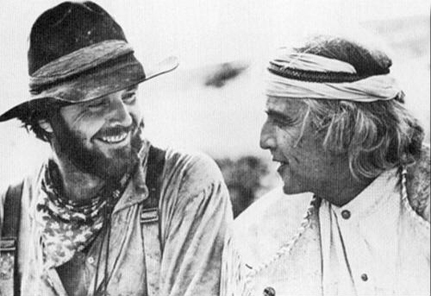
Nicholson and Brando take a break during the filming
Brando sounds far more pessimistic than I had expected, or even imagined. It becomes evident as he talks on that he has been plunged into gloom by what he sees as the planetary crisis just ahead. Art won’t help. Communication won’t solve these problems. The only glimmer of hope he sees is in ecological experiments like those he has wider way on his island in Tahiti. He calls it “the Master. Plan of Tetiaroa-the development of an island so that it can become an ecological paradise.” He is completely serious about this, and as practical as it is possible to be. He explains at length how he plans to use solar energy for the electrolysis of water; how he plans to see what can be done with wave pumps; how he has experiments under way to see if methane gas can be produced in quantity from human waste-literally, shit power.
But what good-he resumes-is communication if it can’t prevent genocide and injustice? “I mean, the reasoning is so devious. The dreams of idealism in one man’s mind are the nightmares of another man. We worry about Russian slave labor camps and ignore torture in Brazil, tui:n our backs on our own shame on the Indian reservations and the ghettos, all of it. We-” He breaks off suddenly, hesitates, then plunges on: “Two gentlemen from the FBI visited me yesterday, asking me questions. And I asked them some. It wound up that we had a two or three-hour conversation. They were. . .” He shrugs. “They were nice men. Their big question was, would I aid a man who was a fugitive from justice?” (Meaning, in particular, the Indians who are now fugitives from the latest shoot-out at Wounded Knee.) “And my big question to them was, if a friend of theirs with the FBI killed someone wrongly, would they turn him in and testify against him? Basically, it’s the same situation looked at from two different sides. A man on the wrong side of the law may be a fugitive from justice, but a man on the right side of the law, if he doesn’t tell the truth, can become a fugitive from the truth. And really, you know, there was such lying, such awful mendacity during that Minneapolis Wounded Knee trial. It was shameful. That’s the kind of thing I was talking about, trying to get the FBI men to face.”
Just about that time a timorous knock comes at the dressing room door, and Brando is informed that it is time to change for the next scene, his second of the day. He nods, says he’ll be ready when they are, and begins shucking off his clothes. He’s overweight-massive but not flabby. Underneath about thirty or thirty-five extra pounds, the boxer’s physique is still there. I make as if to back out of the small cubicle. But he says, “Nah. Stick around. We can resume this after the take. Movies is a compartmentalized business, anyway. “
And that reminds me of something that has always bothered me about the making of movies. “Look,” I say. “I don’t see, considering the process, how any level of dramatic intensity can be maintained from scene to scene.”
He smiles his crooked smile. “It can’t be done. I found that out long ago. I used to leave my performances in the dressing room. I’d get to the set at seven and listen to records to psych up and aU that. Then I’d lose it all before I got up in front of the camera. I honestly think it’s best to take the moment as it comes. It’s that existential thing again we were talking about earlier. But this one’s just a cowboy picture, anyway. Like shooting fish.”
It may be like shooting fish to Marlon Brando, but you’d never know it from the way he goes at it. In all, I saw a couple of scenes in which he was supposed to be stalking Nicholson’s gang of rustlers, spying on them, setting them up for the kill. Each time he did a take, he managed to get a little something extra into it. This is a man who can act with his eyebrows, who will ad lib something in German-in German-when he thinks the script could use a little spritz. And somehow it all makes sense. It adds depth and. dimension to the character. Every little movement has a meaning all its own. lust like the song says.
What he is doing in The Missouri Breaks is challenging himself, introducing elements into the character and plot that may not be quite present in the script. It’s dangerous, it’s chancey, it’s playing close to the line, but he’s willing to take the risk.
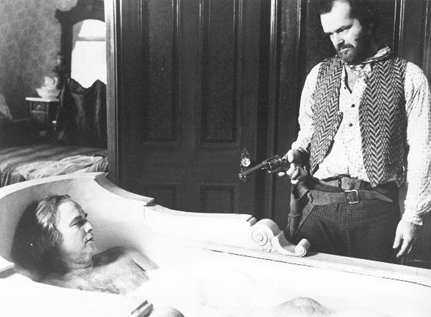
Logan (Nicholson) and Clayton (Brando) in their second confrontation:
“Get on up, you drygulchin’ piece of slime!”
I wind up on the bank of a little creek that feeds into the Yellowstone River a little farther down the line. Right here it’s quiet. The only movement comes from the frogs that jump occasionally, minnows that twist through the clear water, and from a big log-like object bumping slowly along with the current. It is Brando, of course, a crown of grass and creek weeds covering the bit of his head that moves along above the water, all but obscuring the pair of binoculars through which he peers, as he supposedly observes his quarry downstream. The camouflage was his idea. It makes him seem somehow monstrous, like the green man of English folklore.
He does take after take for Penn, soaked, muddy, willing. Then, finished at last, he clowns for a couple of still photographers as the crew packs up, stalking the frogs among the reeds. He grabs at a couple, but they elude him, jumping just ahead. But he has quick hands. He submerges again, calling out to the crowd on the bank. “I’ll get under the water again, like a big crocodile.” He floats just below the surface for a moment, and a fish, not much larger than a minnow, swims close by. In a flash he reaches out and has it. Streaming water, he jumps to his feet, fish in hand, and in practically the same motion, bites it in half.
That causes quite a stir. “Yeccch!” somebody on the bank calls out. There is also some nervous laughter.
Brando grins. “Go ahead and laugh,” he yells to the crew. “You guys don’t know what you’re missing.” Maybe he developed a taste for raw fish in Japan when he was making Sayonara. Or maybe he’s just never lost his desire to shock people once in a while with some new schrecklichkeit-a momentary reversion to the old Brando of The Wild Ones.
Minutes later he is out of the creek, though,. for the day, ready to return to his camper. He invites me onto the back of his Honda for the ride back. I learn then why Jack Nicholson was bouncing around so high on the back of that bike. .
Brando’s camper is modest on the outside and spartan on the inside. There is nothing at all luxurious about it. But he prefers it to a motel room or a house in Billings, because he can be alone here, and he puts great price on his privacy. How does he spend his time? He reads. He wanders around collecting rocks.
“Look at these,” he says, hauling out his rock collection. “They look like they’re not worth shit, but when you lick them”-he does it-“they turn just like magic into something beautiful.” He holds it up for my inspection, and he’s right. It is beautiful. “I got this one by the Yellowstone River. This is great country for rocking.”
As I look at it, he looks at me. “You know, I must say I think your business is haywire when a writer is sent out to talk to a bunch of horse’s asses making a cowboy picture. What has that got to do with anything that advances us? Practically zero. I think the news business is pretty generally screwed up, anyway. On television news, what do you get? Misery squeezed between ho-ho-ho and buy-buy-buy. I don’t know. It seems to me we’re all caught up in the same racket. There’s not a writer around in your business who doesn’t want to go off to a cabin in the woods and write a novel and enjoy the good life. But everybody’s got a family to support. He’s got to get by. It’s a fearsome choice for anyone to try to playa square game.”
Brando pauses for a moment, and then plunges on: “And trying to get at the truth is just about impossible. Listen, let me tell you something. Several years ago I was in Baffin Bay up in Canada all by myself, just me and a bunch of Eskimos in the dead of winter. I fell down on an ice floe and dislocated my hip and broke my wrist. The Eskimos came and got me and put me on a dog sled and took me to an old, old woman in their village, encampment, whatever you’d call it. Anyway, right away she puts a foot in my crotch, takes hold of my leg and twists my foot back into place. The funny thing was it didn’t hurt much. Then-she spoke no English at all-then without a word she gets behind me and started tapping my shoulder in one place. Just tapping, but gradually my wrist grew numb. No feeling in it, and a few minutes before it hurt like hell. She set my wrist then, and I heard the bones crunch, but I felt absolutely nothing. Then she wrapped it in a kind of cast of unborn otter skin, and in a.few days’ time everything was okay. It was amazing! And it shows what utter disregard we have for folk medicine, that we won’t learn what they have to teach us.”
This was great! As far as I know, Brando had never talked about this before. I could tell from the somber, earnest way he talked about it that it had been a harrowing and an important experience for him. And he was revealing it, maybe for the first time, to me. This was what Louella Parsons used to call an “exclusive.”
“Now what I just told you,” Brando resumes for a moment, “was a complete lie. But I just wanted to demonstrate to you what happens when an untruth is presented in a completely serious and straightforward way by a trained liar. That’s what actors are, and so are politicians. Nixon was certainly one of the most skillful. Now, I just conned you, and maybe you’re pissed off at me, but we get conned every day-on television commercials, and in the TV news, and especially when people give speeches. That’s how the news gets screwed up.”
“But what about your own craft?” I put in. “Your own racket. How do you get by in that?”
He shrugs. It’s somehow an ingratiating gesture. “I don’t know. I’m like a lot of old boxers. The more you get hit, the easier it is to take a punch. Pretty soon you’re moving intuitively. You .don’t remember what happened between the fourth and the eighth round, you’re just slipping and ducking, and moving. With me, I go into it, and I say to myself, wbere have I seen this scene before? All these scenes in this movie have been seen nine thousand times before. But you’re locked into a cowboy situation which is admittedly acut above Hoot Gibson, so it’s essential to think of new things to try just to stay ahead of the audiences. Unconsciously, they know how the scene begins and what the actor will say. I’ve got to upset those expectations.”
At about this point I ask about his Indian movie project, and I find that it is much further along than I had realized. It is to be as graphic and honest a statement of the Indians’ situation today as he can make it. There is a script that has been approved and accepted for backing by Columbia Pictures. Brando, as producer of the film, is now acting as go-between, working with the studio and the Indians of the American Indian Movement (AIM), who have total approval, and trying to work out an agree ent on the director so the film can get under way. Would he consider directing it?
“No.” The crooked smile. “I gave that up with One Eyed Jacks.” I tell him I thought that was a good movie and that a lot of other people do, too. He nods his thanks. That is more or less that.
“But you will continue acting, won’t you?” I think it would be a disaster if he really did end his career- for him, for us, for everyone. “What kind of future do you see for yourself?”
He leans forward and says with more urgency than I was prepared for, “I would like to conduct my life and be a part of a society that is as good as grass grows. I’d like to be a blade of grass in concert with other blades of grass. Ants do well; sharks and cockroaches. They survive. I’m for survival.”
There. Chief Joseph, the eloquent, vanquished leader of the Nez Perce Indians, couldn’t have put it better himself. A society as good as grass grows.
Interview- Copyrights United Artists
Important Copyrights Information:
This is a purely non-commercial site intended for entertainment purposes and for Marlon Brando fans around the world. It is primarily intented for people who are unable to access such material. I DO NOT OWN ANY COPYRIGHTS OF THE INTERVIEW LISTED IN THIS PAGE. Though regretted, request for removal of any copyrighted material, by the owner, will be promptly complied with.

No responses yet