
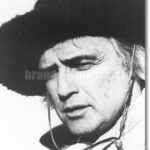
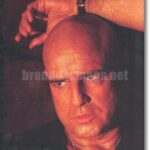
Apocalypse Now, 1979, as Colonel Walter E. Kurtz
Cast: Martin Sheen, Robert Duvall, Dennis Hopper
Director: Francis Ford Coppola

Rating

Factoid
- Director Francis Coppola lost 100 pounds while filming.
- Director Francis Coppola proposed this film ten years before he was given funds to do it. The studio didn’t think he could handle such a large production, so he went and made The Godfather and The Godfather: Part II, becoming extremely famous, rich, and respected.
- Laurence Fishburne lied about his age (he was 14 at the time) when production began in 1976.
- Sheen’s character’s name combines the names of Harrison Ford’s two oldest sons, Benjamin and Willard.
- The sound of the choppers was created on a synthesizer.
- Originally scheduled to be shot over six weeks, ended up taking 16 months.
- Harvey Keitel was originally cast as Captain Willard. Two weeks into shooting, Coppola replaced him with Sheen.
- A typhoon destroyed sets, causing a delay of several months.
- Filmed in the Philippines, where Ferdinand Marcos agreed to supply the helicopters and pilots. Marcos’ government also needed them for fighting the rebels, and sometimes withdrew them during filming, sending different pilots not familiar with the filming.
- Sheen had a heart attack during the filming; some shots of Willard’s back are actually of someone else.
- The photo journalist quotes two T.S. Eliot poems. In a late scene in the film, a slow pan over a table in Kurtz’s room shows a copy of “From Ritual to Romance”, a book by Jessie Weston that inspired Eliot’s poem “The Wasteland”.
- Kurtz reads from the T.S. Eliot poem “The Hollow Men.” Eliot was inspired to write this poem by Joseph Conrad’s “Heart of Darkness,” the book on which this movie was loosely based. The first line of the poem reads, “Mistah Kurtz – he dead.” Kurtz leaves this line and the following line out when he reads. Also, the photojournalist says “This is the way the f***ing world ends. Look at this f***in’ shit we’re in, man. Not with a bang, but with a whimper, and with a whimper, I’m f***ing splitting, Jack.” This is taken from the same poem’s famous last two lines, “This is the way the world ends. Not with a bang but with a whimper.”
- Coppola was unable to find a satisfactory way of ending the film until his wife Eleanor Coppola witnessed the Ifugao natives used as extras performing an animal sacrifice.
- Coppola invested several million dollars of his personal wealth after the film went severely over budget.
- Coppola threatened suicide several times during the making of the film.
- There are three different treatments of the ending and credits. In the 35mm version, the credits roll over surrealistic explosions and burning jungle as the air strike occurs. The 70mm version has none of this, no credits, nothing but a one-line copyright notice at the end. Both versions are available on video. The 70mm version has been letterboxed. A third version has the credits rolling over a black background.
- There are no opening credits or titles. The title of the movie appears as graffiti late in the film.
- An entire set of scenes was cut, in which Willard and company find a river-side French colony. This made the “journey back through time” symbolism more apparent: Vietnam War to French Colony to jungle culture.
- Carmine Coppola (director’s father) wrote the score for this film.
- Harrison Ford’s character wears a name badge which reads “Lucas”. George Lucas directed Ford in American Graffiti (1973) and Star Wars (1977), two films which made Ford famous. G.D. Spradlin’s character is named “R. Corman”, after producer Roger Corman.
- Directors Cameo (Coppola, Francis): filming a war documentary.
- Eleanore Coppola filmed and recorded the making of this film, leading to “Hearts of Darkness: A Filmmaker’s Apocalypse” (1991).
- The character of the photojournalist (Dennis Hopper) was reportedly inspired by legendary photographer Tim Page, author of “Nam” and “Derailed in Uncle Ho’s Victory Garden,” among others.
- Robert Duvall and Dennis Hopper leave the film the exact same way: by standing up from a squatting position and walking out of the frame to the right.
- Scenes featuring Aurore Clément as the owner of a French plantation were filmed but cut from the finished picture.
- Writer Michael Herr was called in to write much of Willard’s voiceover dialogue and a few scenes. The scene where Roach uses a grenade launcher to kill the NVA soldier in the wire during the scene at the Do Long bridge is taken directly from “Dispatches,” Herr’s memoir as a freelance Marine journalist during the war.
- Besides being a straightforward pun, Col. Kilgore’s name is also the name of the home town of a gung-ho helicopter door gunner described by writer Michael Herr in his book “Dispatches.”


Quotes from the movie
Captain Willard: Saigon. Shit. I’m still only in Saigon. Every time I think I’m gonna wake up back in the jungle. When I was home after my first tour, it was worse. I’d wake up and there’d be nothing. I hardly said a word to my wife, until I said ‘yes’ to a divorce. When I was here I wanted to be there. When I was there, all I could think of was getting back into the jungle. I’m here a week now. I’m waiting for a mission – getting softer. Every minute I stay in this room, I get weaker. And every minute Charlie squats in the bush, he gets stronger. Each time I looked around, the walls moved in a little tighter.
Captain Willard: Everyone gets everything he wants. I wanted a mission, and for my sins, they gave me one. They brought it up to me like room service…It was a real choice mission – and when it was over, I never want another…I was going to the worst place in the world, and I didn’t even know it yet. Weeks away and hundreds of miles up a river that snaked through the war like a main circuit cable plugged straight into Kurtz. It was no accident that I got to be the caretaker of Colonel Walter E. Kurtz’s memory, any more than being back in Saigon was an accident. There is no way to tell his story without telling my own. And if his story is really a confession, then so is mine.
[A tape recording of Kurtz’s voice]
Kurtz: I watched a snail crawl along the edge of a straight razor. That’s my dream, it’s my nightmare. Crawling, slipping along the edge of a straight razor and surviving….But we must kill them, we must incinerate them, pig after pig, cow after cow, village after village, army after army, and they call me an assassin. What do you call it when the assassins accuse the assassin? They lie. They lie and we have to be merciful for those who lie, for those nabobs. I hate them. I do hate them.
[General Corman describes Kurtz’s temptation to be deified]
General Corman: Because there’s a conflict in every human heart between the rational and the irrational, between the good and the evil. The good does not always triumph. Sometimes the dark side overcomes what Lincoln called the better angels of our nature. Therein, man has got a breaking point. You and I have. Walter Kurtz has reached his. And very obviously, he has gone insane.
Colonel Lucas: Your mission is to proceed up the Nung River in a Navy patrol boat. Pick up Colonel Kurtz’s path at Nu Mung Ba, follow it and learn what you can along the way. When you find the Colonel, infiltrate his team by whatever means available and terminate the Colonel’s command.
Captain Benjamin L. Willard: Terminate the Colonel.
General Corman: He’s out there operating without any decent restraint, totally beyond the pale of any acceptable human conduct. And he is still in the field commanding troops.
Civilian: Terminate with extreme prejudice.
Colonel Lucas: You understand Captain that this mission does not exist, nor will it ever exist.
Williard: At first, I thought they handed me the wrong dossier. I couldn’t believe they wanted this man dead. Third generation West Point, top of his class. Korea, Airborne. About a thousand decorations. Etcetera, etcetera. I’d heard his voice on the tape and it really put the hook in me. But I couldn’t connect up that voice with this man. Like they said, he had an impressive career, maybe too impressive, I mean perfect. He was being groomed for one of the top slots in the corporation: General, Chief of Staff, anything. In 1964, he returned from a tour with advisory command in Vietnam and things started to slip. His report to the Joint Chiefs of Staff and Lyndon Johnson was restricted. It seems they didn’t dig what he had to tell ’em. During the next few months, he made three requests for transfer to Airborne training, Ft. Benning, Georgia and was finally accepted. Airborne? He was thirty-eight years old. Why the f*** would he do that? 1966: Joined Special Forces, returns Vietnam.
Willard: Don’t you think it’s a little risky for R and R? Kilgore: If I say it’s safe to surf this beach, Captain, it’s safe to surf this beach. I’m not afraid to surf this place…(He rips off his own shirt.)
Kilgore: What the hell do you know about surfing? You’re from goddamned New Jersey.
Kilgore: You smell that? Do you smell that?…Napalm, son. Nothing else in the world smells like that. I love the smell of napalm in the morning. You know, one time we had a hill bombed, for twelve hours. When it was all over I walked up. We didn’t find one of ’em, not one stinkin’ dink body. The smell, you know that gasoline smell, the whole hill. Smelled like – victory. Some day, this war’s gonna end.
[Willard questions what the real reason might be for the orders to assassinate Kurtz]Willard: If that’s how Kilgore fought the war, I began to wonder what they really had against Kurtz. It wasn’t just insanity and murder. There was enough of that to go around for everyone.
Freelance Photographer: You don’t talk to the Colonel, you listen to him. The man’s enlarged my mind. He’s a poet-warrior in the classic sense…I’m a little man. He’s a great man. I should have been a pair of ragged claws, scuttling across floors of silent seas, I mean…He can be terrible. He can be mean. And he can be right. He’s fighting a war. He’s a great man.
Freelance Photographer: The heads. You’re lookin’ at the heads. Eh, uh-sometimes he goes too far, you know, and he’s the first one to admit it.
Kurtz: Did they say why, Willard, why they want to terminate my command?
Willard: I was sent on a classified mission, sir.
Kurtz: It’s no longer classified, is it? Did they tell you?
Willard: They told me that you had gone totally insane and that your methods were unsound.
Kurtz: Are my methods unsound?
Willard: I don’t see any method at all, sir.
Kurtz: I expected someone like you. What did you expect? Are you an assassin?
Willard: I’m a soldier.
Kurtz: (disdainfully) You’re neither. You’re an errand boy, sent by grocery clerks to collect a bill.
Freelance Photographer: Why would a nice guy like you want to kill the genius?…The man is clear in his mind, and his soul is mad. Oh yeah. He’s dying, I think. He hates all of this. He hates it, but the man’s, uh…He likes you cause you’re still alive. He’s got plans for you…You’re gonna help him, man…What are they gonna say man when he’s gone…he was a kind man? He was a wise man? He had plans, he had wisdom? Bulls–t man.
Willard: On the river, I thought that the minute I looked at him, I’d know what to do, but it didn’t happen. I was in there with him for days, not under guard – I was free – but he knew I wasn’t going anywhere. He knew more about what I was going to do than I did. If the generals back in the Trang could see what I saw, would they still want me to kill him? More than ever probably. And what would his people back home want if they ever learned just how far from them he’d really gone? He broke from them and then he broke from himself. I’d never seen a man so broken up and ripped apart.
Kurtz: …you have no right to call me a murderer. You have a right to kill me – you have the right to do that – but you have no right to judge me.
Kurtz: It’s impossible in words to describe what is necessary to those who do not know what horror means. Horror. Horror has a face, and you must make a friend of horror. Horror and moral terror are your friends. If they are not, then they are enemies to be feared. They are truly your enemies.
Kurtz: We left the camp after we had inoculated the children for polio, and this old man came running after us and he was crying, he couldn’t see. We went back there, and they had come and hacked off every inoculated arm. There they were in a pile, a pile of little arms, and I, I remember I…I…I cried, I wept like some grandmother. I wanted to tear my teeth out. I didn’t know what I wanted to do. And I want to remember it. I never want to forget it. I never want to forget. And then I realized like I was shot, like I was shot with a diamond, a diamond bullet right through my forehead, and I thought, my God, the genius of that, the genius, the will to do that – perfect, genuine, complete, crystalline pure! Then I realized they were stronger than we…They have the strength, the strength to do that. If I had ten divisions of those men, then our troubles here would be over very quickly. You have to have men who are moral and at the same time who are able to utilize their primordal instincts to kill without feeling, without passion, without judgment – without judgment. Because it’s judgment that defeats us.
Kurtz: …he might not understand what I’ve tried to be and if I were to be killed, Willard, I would want someone to go to my home and tell my son everything. Everything I did, everything you saw, because there’s nothing I detest more than the stench of lies. And if you understand me, Willard, you will do this for me?
Willard: They were going to make me a Major for this and I wasn’t even in their f***in’ army any more. Everybody wanted me to do it, him most of all. I felt like he was up there, waiting for me to take the pain away. He just wanted to go out like a soldier, standing up, not like some poor, wasted, rag-assed renegade. Even the jungle wanted him dead, and that’s who he really took his orders from anyway.
[Kurtz’s few final final words]
The horror. The horror.

“Behind the Scenes”
Revealing mistakes: The magnetic tape on the reel-to-reel player in the helicopter doesn’t pass over the play heads.
Continuity: The blades of the Huey helicopter when the Playmate of the Year arrives.
Crew or equipment visible: When pulling out from the Dulong bridge you can see the wake caused by the camera boat when the camera shows the boat pulling away.
Anachronisms: The Army didn’t have the 30-round “banana” clips portrayed in the movie until the mid-seventies.
Continuity: Thickness of pages when Willard flips through Kurtz’s manuscripts after he is killed.
Factual errors: The maximum gross weight of a Huey helicopter is 10,500 pounds. It would be impossible for such an aircraft to lift a Patrol Boat, Riverine (PBR) which weighs anywhere between 15,000 and 19,000 pounds.
Continuity: After the canopy of the boat is destroyed and is replaced by giant leaves, the canopy reappears while they are at the bridge. In subsequent shots after, the canopy is gone again and replaced by the leaves.
Continuity: Kilgore talks about surfing Charlies Point. When we see it, it is obviously a beach break, not a point break.
Continuity: At times during the arrow/spear attack, with the crew at the gun positions and the Chief leaving the boat’s wheelhouse to confront Willard, an extra crewman appears at the helm for a few seconds.
Continuity: When attacking the village, Kilgore’s helicopter has rocket pods on each side and no surfboards. When it lands it has surfboards on each side and no rocket pods.
Incorrectly regarded as goofs: As Willard flips through Kurtz’s dossier, the voiceover says, “Third generation West Point, top of his class” while the dossier clearly reads, “Graduates West Point; second in class.” Second is still reasonably considered “top of the class.”
Revealing mistakes: The tape player that “Clean” picks up to play his mother’s taped letter has no batteries in the bottom.
No responses yet